
 By Tsuky
A $65 billion run rate does not mean $65 billion has already been earned this year
Reuters reports that Anthropic's annualized revenue run rate exceeded $65 billion by the end of July, up from the more than $47 billion the company publicly announced in May.
An annualized run rate is not the same thing as annual revenue already booked. It extrapolates a recent level of business over twelve months to indicate the company's current pace.
That distinction becomes especially important when growth is this fast. In February, Anthropic was still publishing a chart showing a $14 billion run rate.
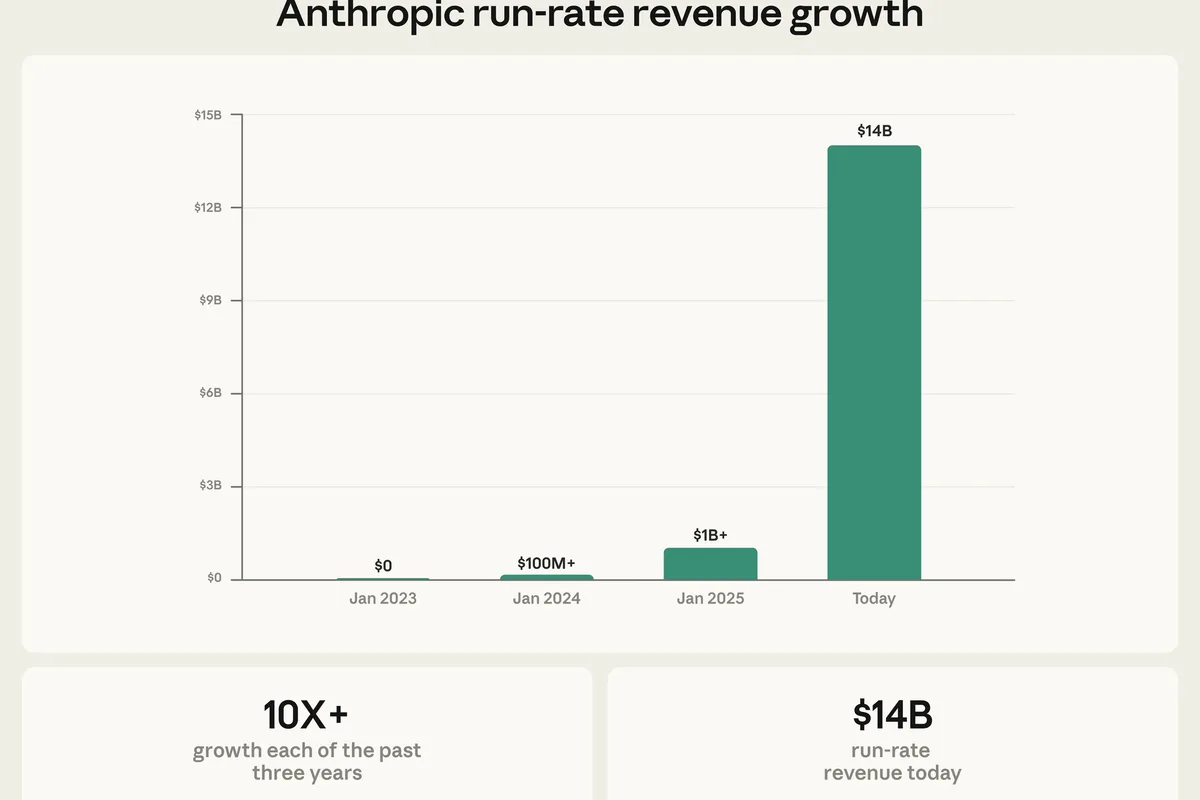
That chart is already more historically useful than current. It illustrates less about Anthropic's present size than about the speed at which the metrics used to describe that size become obsolete.
The credit line is not another $10 billion equity raise
Bloomberg, as reported by Reuters on August 18, says Anthropic is working on a revolving credit facility targeting roughly $10 billion and potentially more.
Such a structure places borrowing capacity at the company's disposal. It does not necessarily mean Anthropic will immediately draw the entire amount.
It is a form of financial flexibility that can be particularly useful for a company whose spending and investment requirements can shift rapidly with model deployments, computing contracts and customer demand.
The final amount itself remains unsettled. Negotiations continue, and the facility could ultimately end above, at or below the reported target.
The cost that cannot be ignored is compute
Anthropic is not building conventional software where the marginal cost of another user is primarily a small amount of ordinary server capacity.
A model like Claude depends on specialized infrastructure for training and then consumes computing resources every time it serves production workloads. At very large scale, available capacity becomes a strategic constraint alongside model quality itself.
In May, Anthropic announced agreements with AWS for up to five gigawatts of new capacity. It also said it had an agreement with Google and Broadcom for five gigawatts of next-generation TPU capacity and access to SpaceX GPUs in Colossus 1 and Colossus 2.
AWS remains Anthropic's primary cloud provider and training partner, according to the company, while Claude is also offered through Google Cloud and Microsoft Azure.
Ten gigawatts says more about the scale than ten billion dollars of credit
The announced AWS and Google-Broadcom agreements represent up to ten gigawatts of potential capacity before other arrangements are counted.
That does not mean Anthropic instantly consumes ten gigawatts continuously. These are capacity commitments that come online according to the relevant contracts and deployment schedules.
But the unit itself shows how the industry has changed. Frontier-model companies are no longer negotiating only for servers or GPU clusters. They are securing infrastructure volumes that resemble major industrial and energy projects.

At that scale, maintaining several sources of financing is unsurprising. Equity funds expansion, credit provides flexibility, and cloud or infrastructure partners supply part of the capacity required to operate.
Anthropic has already raised $65 billion
In May, Anthropic announced a $65 billion Series H at a $965 billion post-money valuation. That followed a $30 billion Series G at a $380 billion valuation in February.
A new credit facility a few months later does not necessarily mean that equity has already been consumed. Debt and equity do not perform exactly the same function.
Equity financing gives new investors an economic stake in the company. A bank facility instead creates repayment obligations and financing costs, but avoids issuing additional ownership for every temporary liquidity requirement.
Using both mechanisms is therefore reasonable for a company growing rapidly while funding infrastructure commitments whose payment schedules may not perfectly match customer cash flows.
The IPO will make these economics far more visible
Anthropic confidentially filed for a U.S. IPO in June. The terms of the offering remain private at this stage.
Once publicly traded, however, the company will face much more regular scrutiny of its finances. Investors will be able to compare revenue growth, cash requirements, investment, margins and computing costs quarter by quarter.
That is especially important in frontier AI, where efficiency improvements can materially reduce inference costs while a new model generation can simultaneously require a much larger infrastructure footprint.
Profitability therefore depends on more than customer count. It depends on how much computation is required to serve those customers, what Anthropic pays for that capacity and whether technical efficiency can improve faster than spending grows.
The $200 billion figure for 2028 remains a projection
Reuters reports that Anthropic is using projections of roughly $190 billion to $200 billion in 2028 revenue as part of its financial preparations.
That figure matters for understanding a potential valuation, but it is neither an achieved result nor a publicly guaranteed forecast from the company.
Reaching that scale while expanding margins would require several variables to improve at once: more customers, more usage, better model efficiency and infrastructure costs that grow more slowly than revenue.
The downside works the same way. Slower demand, model price competition or higher computing costs could quickly make an extraordinary projection much harder to achieve.
Anthropic's paradox is really the frontier AI industry's paradox
The numbers can make Anthropic look like a company that is simultaneously awash in money and constantly searching for more financing.
That is precisely what defines the current frontier AI phase. Revenue can grow at a pace rarely seen in software, while infrastructure requirements expand in ways that look more like telecommunications, energy or major industrial development.
The roughly $10 billion credit facility reported by Bloomberg is therefore more than a pre-IPO curiosity. It illustrates the question future Anthropic shareholders will have to learn to ask: not simply how much money Claude generates, but how much capital and computation are required to produce each additional stage of that growth.
The IPO will make that equation much less abstract. And for an industry accustomed to comparing models through benchmarks, the most unforgiving benchmark may soon arrive every quarter: revenue, margins and the billions required to keep artificial intelligence operating at this scale.